

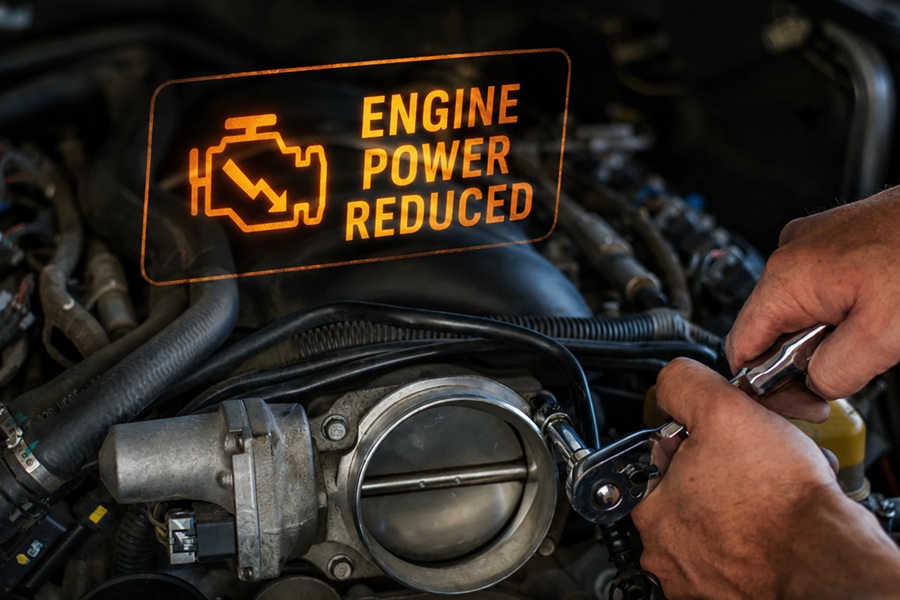

Seeing an engine power reduced warning on your dashboard can be stressful, especially if your car suddenly feels slow, weak, or hesitant while you are driving. The good news is that this message does not usually mean your engine has completely failed. Instead, it means your vehicle’s computer has detected a problem and has limited engine performance to protect the vehicle from further damage.
This limited-performance state is often called limp mode or reduced power mode. Your car may still run, but it will not accelerate normally, may struggle to climb hills, and may have a limited top speed. Because this can become a safety issue in traffic, it is important to know what the warning means, what causes it, and what you should do next.
What Does “Engine Power Reduced” Mean?
The engine power reduced message means your vehicle’s computer has found a fault in one of the systems that affects engine performance. To prevent possible damage, the computer intentionally limits how much power the engine can produce.
Modern vehicles rely on many sensors, wires, modules, and electronic controls. These systems constantly monitor engine speed, throttle position, air intake, fuel delivery, and other important functions. If the computer receives information that does not look right, it may reduce engine power as a protective measure.
When this happens, you may notice:
- Slow or weak acceleration
- Limited vehicle speed
- Poor throttle response
- Difficulty merging or passing
- The check engine light turning on
- The vehicle feeling like it is “holding back”
This warning should not be ignored. Even if the car still drives, the reduced power mode is a sign that something needs attention.
Why Your Car Limits Engine Power
Your vehicle limits engine power to protect itself. If a problem affects the throttle system, sensors, fuel delivery, or engine management system, allowing the car to operate at full power could cause more serious damage.
Think of reduced power mode as your car’s way of saying, “Something is wrong, so I’m going to slow down to avoid making it worse.”
This can help prevent damage to expensive components and give you enough control to move the vehicle to a safer location. However, it is not meant to be a long-term driving mode. The warning means the vehicle needs to be checked and repaired.
Common Causes of an Engine Power Reduced Warning
There are several possible reasons why your car may show an engine power reduced message. The exact cause depends on the make, model, and diagnostic trouble codes stored in the vehicle’s computer.
Here are some of the most common causes.
- Throttle Body Problems
The throttle body controls how much air enters the engine. In many modern vehicles, the throttle body is electronically controlled instead of being connected directly to the gas pedal by a cable.
If the throttle body becomes dirty, sticks, or fails electronically, the computer may limit engine power. A faulty throttle body can cause poor acceleration, rough idling, stalling, or reduced power.
- Accelerator Pedal Sensor Issues
Your gas pedal has sensors that tell the computer how much acceleration you are requesting. If the accelerator pedal position sensor sends incorrect or inconsistent signals, the computer may not trust the input.
When that happens, it may reduce engine power to avoid unsafe acceleration or unpredictable throttle response.
- Throttle Position Sensor Failure
The throttle position sensor monitors the position of the throttle plate. If this sensor gives inaccurate readings, the engine control module may not know how much air is entering the engine.
This can cause the vehicle to enter reduced power mode, especially if the readings do not match what the accelerator pedal sensor is reporting.
- Faulty Engine Sensors
Your engine depends on several sensors to run properly. A failing sensor can cause incorrect fuel, air, or timing adjustments. If the computer detects a serious sensor problem, it may trigger the engine power reduced warning.
Possible sensor-related causes include:
- Mass airflow sensor problems
- Manifold absolute pressure sensor issues
- Oxygen sensor faults
- Crankshaft or camshaft position sensor problems
- Coolant temperature sensor failure
Not every sensor issue will cause reduced power, but many can affect engine performance.
- Wiring or Electrical Problems
Sometimes the issue is not the part itself but the wiring connected to it. Damaged wires, loose connectors, corrosion, or poor electrical connections can interrupt communication between sensors and the vehicle’s computer.
Electrical problems can be tricky because they may come and go. For example, the warning may appear one day, disappear the next, and return later. Even if the message goes away, the stored trouble codes can help a technician find the source of the problem.
- Engine Control Module Issues
The engine control module, or ECM, is the computer that manages engine operation. ECM failure is less common than sensor or wiring problems, but it can happen.
Before replacing a control module, a proper diagnosis should be done. Many ECM-related symptoms are actually caused by weak batteries, poor grounds, damaged wiring, or failed sensors.
- Transmission or Traction Control Problems
In some vehicles, reduced engine power can be connected to transmission or traction control issues. If the system detects wheel slip, shifting problems, or drivetrain faults, it may limit engine power to protect the vehicle and maintain control.
This is why reading the diagnostic trouble codes is so important. The warning may appear to be engine-related, but the root cause can sometimes involve another system.
Is It Safe to Drive With Reduced Engine Power?
You may be able to drive a short distance with reduced engine power, but you should not continue driving normally. Limited power can make everyday driving situations more dangerous.
For example, your vehicle may not accelerate quickly enough to merge onto a highway, pass another car, or climb a steep hill. If you are in heavy traffic, this can create a real safety risk.
If the warning appears while driving:
- Stay calm.
- Avoid sudden acceleration.
- Turn on your hazard lights if needed.
- Move to the right lane when safe.
- Find a safe place to pull over.
- Do not continue a long trip without having the vehicle checked.
If the car is shaking badly, overheating, making unusual noises, or the check engine light is flashing, stop driving as soon as it is safe and consider calling for roadside assistance.
What to Do When the Warning Appears
The best response to an engine power reduced warning is to treat it seriously but calmly. Here is what you should do.
Step 1: Get to a Safe Location
Your first priority is safety. Because your vehicle may not accelerate normally, avoid risky maneuvers. Pull into a parking lot, side street, or safe shoulder if necessary.
Step 2: Turn the Vehicle Off and Restart It
In some cases, turning the car off and restarting it may temporarily clear the reduced power mode. However, this does not mean the problem is fixed. If the warning comes back, or if the check engine light remains on, the vehicle still needs diagnosis.
Step 3: Check for Obvious Problems
If it is safe to do so, look for simple warning signs. Check whether the vehicle is overheating, whether there are strange smells, or whether you notice smoke or leaking fluids. If anything seems serious, do not keep driving.
Step 4: Read the Diagnostic Trouble Codes
The most important step is scanning the vehicle for diagnostic trouble codes. These codes help identify which system triggered the warning.
An auto repair shop can perform a full diagnosis. Some auto parts stores may also read basic check engine codes, but a complete diagnosis usually requires more than just reading the code. A technician may need to inspect wiring, test sensors, check live data, and verify the cause before replacing parts.
Step 5: Repair the Underlying Problem
Reduced power mode will not be properly resolved until the actual fault is repaired. Replacing random parts can become expensive and may not fix the issue. A proper diagnosis helps avoid unnecessary repairs.
Can Low Oil Cause Engine Power Reduced?
Low oil can cause serious engine problems, but it is not always the direct reason for an engine power reduced warning. However, if low oil pressure or engine protection systems detect a serious issue, the vehicle may limit performance.
If your oil pressure warning light comes on, stop driving as soon as it is safe. Low oil pressure can cause major engine damage.
Can a Bad Battery Cause Reduced Engine Power?
Yes, a weak battery or charging system problem can sometimes contribute to reduced power warnings. Modern vehicles rely heavily on stable voltage. If the battery, alternator, or electrical grounds are failing, sensors and control modules may not communicate correctly.
If your vehicle has electrical symptoms such as dim lights, slow starting, multiple warning lights, or random dashboard messages, the battery and charging system should be tested.
How Much Does It Cost to Fix?
The repair cost depends on the cause. A simple cleaning of the throttle body may cost much less than replacing a sensor, repairing wiring, or replacing a control module.
Common repair ranges may include:
- Throttle body cleaning: lower cost
- Sensor replacement: moderate cost
- Wiring repair: varies widely
- Throttle body replacement: moderate to higher cost
- Control module replacement: higher cost
Because the causes vary, the best way to avoid wasting money is to start with a proper diagnostic inspection.
Final Thoughts
The engine power reduced warning means your vehicle has detected a problem and has limited engine performance to protect itself. While your car may still drive, it should not be driven normally or ignored.
Reduced power can make it harder to accelerate, merge, or handle traffic safely. The safest response is to stay calm, drive carefully, get to a safe location, and have the vehicle diagnosed as soon as possible.
In many cases, the issue may involve the throttle system, sensors, wiring, or engine management components. A diagnostic scan can point technicians in the right direction, but proper testing is important before replacing parts.
Addressing the warning promptly helps restore normal performance, prevents possible further damage, and keeps your vehicle safer to drive.